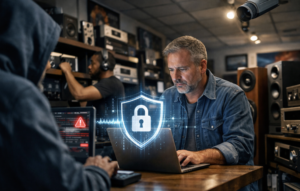
Trust is everything in retail, and that is especially true for businesses that sell premium audio equipment, home theater systems, custom installations, and high-value electronics. Customers do not just expect great sound. They expect secure transactions, protected personal information, reliable communication, and a business they can feel confident buying from again and again. That is exactly why Audio Stores need to treat cybersecurity as a business priority instead of a background IT issue.
Today’s cyber threats are not limited to giant corporations. Small and mid-sized businesses are being targeted every day because attackers know many local businesses have weaker defenses, fewer formal policies, and a lot to lose if systems go down. The FBI’s 2024 Internet Crime Report says the IC3 received 859,532 complaints and reported losses exceeded $16 billion, showing just how large and expensive online crime has become.
For audio retailers, one successful attack can damage far more than a computer network. It can interrupt online orders, expose customer payment information, freeze point-of-sale systems, disrupt installer scheduling, lock staff out of email, and weaken the reputation that took years to build. In a market where personal service and word-of-mouth matter, cybersecurity is now part of customer experience, brand credibility, and long-term growth.
Cybersecurity Is Now a Core Business Issue
Many business owners still think of cybersecurity as something technical that belongs only to an outside IT company. That mindset is outdated. Cybersecurity is really about business continuity, risk management, customer trust, and operational stability. Computer security is fundamentally about protecting systems, networks, and data from unauthorized access, theft, disruption, or damage. That definition may sound broad, but for an audio store, it is very practical. It applies to your website, checkout systems, customer records, financing applications, internal messaging, cloud storage, remote access tools, and even smart devices on your network.
An audio store often handles more sensitive digital information than many owners realize. Customer names, phone numbers, addresses, invoices, installation notes, warranty records, credit applications, and payment details all create value for criminals. Add employee logins, vendor accounts, remote monitoring tools, and online ordering platforms, and the attack surface grows fast. What looks like a simple retail business on the outside may actually be a layered digital operation behind the scenes.
That is why cybersecurity can no longer be treated like a one-time software purchase. It needs to be woven into how the business operates every day.
Why Audio Stores Are Attractive Targets
Audio stores may not think of themselves as obvious cyber targets, but attackers do not only chase household-name brands. They often look for companies with valuable data, payment activity, and limited security maturity. Local retailers can be attractive because they are busy, customer-facing, and often rely on a mix of older systems and newer digital tools.
Audio stores also tend to sell expensive products. That creates attractive opportunities for fraud, account takeovers, fake vendor emails, stolen cards, and order manipulation. A criminal does not need to steal an entire database to cause real damage. One compromised email account can redirect payments, impersonate ownership, or trick staff into sending invoices or wiring money to the wrong place.
Cybercriminals are also taking advantage of identity-based attacks more than ever. Microsoft’s Digital Defense Report 2025 and Verizon’s 2025 Data Breach Investigations Report both point to a threat environment where credential theft, ransomware, and real-world breach activity continue to pressure businesses of every size. Verizon’s 2025 reporting notes a record level of confirmed data breaches in its dataset, showing how active the landscape has become.
For an audio store, the cost of an incident is not only financial. It can also mean cancelled appointments, angry customers, missed leads, delayed installations, damaged search visibility from website downtime, and a hard hit to reputation.
The Hidden Risks Inside Everyday Operations
A lot of cybersecurity risk lives inside normal daily routines. An employee clicks a fake shipping notification. A manager reuses a password across multiple systems. A sales associate logs into store email on unsecured public Wi-Fi. A website plugin goes unpatched. A point-of-sale terminal stays on an outdated operating system. A bookkeeper receives an invoice that looks legitimate but is actually a scam.
These are not dramatic Hollywood-style breaches. They are common business moments that attackers exploit over and over.
That is why guidance from organizations like CISA’s Cyber Guidance for Small Businesses, the FTC’s Cybersecurity for Small Business, and the FCC’s cybersecurity resources for small businesses matters so much. These resources make it clear that smaller organizations are not exempt from serious risk and that practical protections such as strong passwords, multi-factor authentication, backups, patching, and employee awareness are foundational, not optional.
For audio stores, the danger is magnified because the business often relies on speed and responsiveness. Leads need quick follow-up. Orders need accurate fulfillment. Install teams need schedules and site notes. If systems are compromised, even a short interruption can affect revenue immediately.
Ransomware Can Shut Down Revenue Fast
One of the most serious threats facing retail and service businesses is ransomware. A ransomware event can lock up files, freeze operations, and force a business into a costly recovery process. NIST’s guidance on ransomware and its broader work on ransomware protection and response make clear that preparation matters before an attack ever happens. Backups, access controls, system hardening, and recovery planning are not luxuries. They are part of staying open.
For an audio store, ransomware can halt nearly every revenue-producing activity at once. The website may become unavailable. Email may stop working. Customer orders may become inaccessible. Accounting systems may freeze. Installer calendars may disappear. If the business uses network-connected showroom tools, those can be affected as well.
Even when a company eventually recovers, the disruption itself can be expensive. Lost sales, delayed projects, overtime labor, emergency IT costs, reputational fallout, and customer frustration all add up. That is why prevention is far cheaper than cleanup.
Cybersecurity Builds Trust, Authority, and Long-Term Brand Strength
There is another reason cybersecurity matters more than ever for audio stores. It strengthens trust signals that influence how customers, vendors, and search engines perceive a business.
A secure, professionally managed digital presence supports brand authority. When a website runs smoothly, loads reliably, uses HTTPS, protects forms, and avoids spam or malware issues, it creates confidence. When customer communication is consistent and protected, it supports loyalty. When a business demonstrates that it takes data protection seriously, it positions itself as stable, modern, and responsible.
That matters in real-world reputation, and it also supports the kind of online credibility businesses want to build over time. Strong site health, dependable uptime, secure architecture, and high-quality outbound references all contribute to a more trustworthy web presence. Linking thoughtfully to respected sources such as NIST’s Cybersecurity Framework, CISA cybersecurity best practices, and current breach intelligence from major organizations helps reinforce topical relevance and authority around IT and security conversations.
In other words, cybersecurity is not separate from digital authority. It supports it.
What Audio Store Owners Should Prioritize Right Now
The strongest cybersecurity strategy is not built on panic. It is built on disciplined basics done consistently.
Audio store owners should make sure all core systems are updated regularly, especially websites, ecommerce tools, plugins, firewalls, routers, and point-of-sale environments. Multi-factor authentication should be enabled anywhere it is available, especially for email, financial software, website administration, and remote access accounts. Backups should be automatic, tested, and separated from the main network. Staff should be trained to spot phishing emails, suspicious invoice requests, and login scams. Access should be limited so employees only have the permissions they actually need.
It is also wise to map out where sensitive data lives. Many businesses are surprised to find customer information scattered across inboxes, shared drives, PDFs, old spreadsheets, and personal devices. Cleaning that up reduces risk immediately.
Small businesses can also benefit from using free and authoritative planning tools. CISA, NIST, FTC, FCC, and SBA all provide guidance meant specifically for smaller organizations that need practical steps, not enterprise jargon. Their shared message is clear: cyber resilience starts with leadership, process, and consistency, not just technology.
Conclusion
Cybersecurity matters more than ever for audio stores because the modern audio retail business is no longer just a showroom. It is a digital operation, a customer data environment, a communications hub, a payment processor, and a reputation engine all at once. That makes it vulnerable, but it also makes proactive security one of the smartest investments a business can make.
The stores that treat cybersecurity seriously are not simply trying to avoid disaster. They are protecting customer trust, preserving revenue, strengthening brand credibility, and building a more stable foundation for growth. In a competitive market where service, confidence, and reliability matter, strong cybersecurity is part of what makes a business sound trustworthy before a customer ever hears the first speaker play.