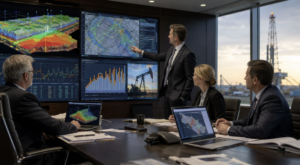
Oil and gas valuation disputes rarely turn on a single number. They involve production histories, royalty statements, lease provisions, geological records, market forecasts, ownership interests, operating expenses, tax information, and years of correspondence. A credible expert must be able to gather that material, understand it, verify it, and explain how it affects value.
Information technology has changed every stage of that process.
The modern expert witness is no longer limited to reviewing boxes of paper records, manually entering figures into spreadsheets, and preparing a handful of static courtroom exhibits. Secure cloud platforms, advanced data-analysis tools, geographic information systems, digital document repositories, and interactive visualizations now allow experts to examine larger collections of information with greater speed and precision.
Technology does not replace professional judgment. It gives qualified experts better ways to organize evidence, test assumptions, identify inconsistencies, and communicate complex findings. In high-stakes oil and gas litigation, those capabilities can make testimony clearer, more defensible, and easier for attorneys, judges, and juries to understand.
IT Is Changing How Valuation Evidence Is Collected 💻
Oil and gas valuation assignments often begin with a large and disorganized collection of records. An expert may receive production reports, division orders, deeds, leases, title opinions, engineering studies, operating statements, emails, maps, tax records, and prior appraisals from several different parties.
In the past, reviewing that material could require weeks of manual sorting. Important documents might be stored in unrelated folders, duplicated under different names, or delivered in incompatible formats. Current information technology tools make it possible to collect these materials within a searchable digital environment.
Optical character recognition can make scanned records searchable. Document-management systems can organize files according to property, well, owner, date, or legal issue. Metadata can help establish when a file was created or modified. Duplicate-detection tools can reduce the time spent reviewing identical records.
This broader shift reflects the practical role of technology described in Wikipedia’s overview of information technology. Information systems are designed to store, retrieve, transmit, and work with data, all of which are central to a modern valuation investigation.
Better document organization does more than save time. It helps an expert establish a reliable foundation for the opinions that may eventually be presented in a report, deposition, hearing, or trial.
Large Production Datasets Can Be Examined More Efficiently
A single mineral interest may be connected to years of monthly production figures, commodity prices, operating expenses, royalty payments, taxes, deductions, and ownership changes. A dispute involving multiple wells or properties can produce tens of thousands of individual data points.
IT systems allow experts to process those records far more efficiently than traditional manual methods. Data can be imported from spreadsheets, accounting platforms, production databases, regulatory filings, and document repositories. Once the information has been standardized, an expert can search for trends, missing entries, unexplained changes, or calculations that do not match the underlying records.
For example, an expert may compare reported production against royalty payments, evaluate whether deductions were applied consistently, or identify months in which revenues changed sharply without a corresponding change in production. Those findings do not automatically prove that an error occurred, but they can reveal areas that require closer investigation.
Technology publications such as Reuters Technology regularly cover developments in data infrastructure, artificial intelligence, cybersecurity, and enterprise computing. These technologies increasingly influence how professionals in technical and financial fields handle complex information.
The value of data analysis is not simply speed. It is repeatability. When a calculation is challenged, the expert should be able to explain where the information came from, what adjustments were made, and how the final result was produced.
Digital Audit Trails Strengthen the Valuation Process
A valuation opinion must be supported by more than a polished final number. The expert should be able to demonstrate how the analysis progressed from the original records to the conclusion.
Digital audit trails make that process easier to document.
A well-managed system can preserve the source of each dataset, record when information was received, track revisions, and distinguish original records from working copies. Version-control practices can prevent an outdated spreadsheet or report from being mistaken for the final analysis.
This becomes especially important when multiple professionals are involved. Attorneys, paralegals, accountants, engineers, geologists, land professionals, and valuation experts may all contribute information. Without a structured system, different team members can unintentionally work from different versions of the same file.
Enterprise platforms covered by TechCrunch’s enterprise technology reporting illustrate how cloud software, data-management systems, and collaborative tools continue to change professional workflows.
For expert testimony, a clear digital record supports transparency. It allows the expert to retrace the work, verify important calculations, and respond more confidently when opposing counsel asks how a particular figure was developed.
GIS Technology Adds Geographic Context to Valuation
Oil and gas assets are tied directly to location. Formation characteristics, lease boundaries, well spacing, transportation access, nearby development, regulatory conditions, and regional production activity can all affect an asset’s value.
Geographic information systems allow an expert to combine maps with ownership, geological, production, and infrastructure data. Instead of reviewing each category separately, the expert can see how the information relates spatially.
GIS may be used to display leasehold boundaries, producing wells, offset wells, pipelines, roads, surface features, drilling activity, or geological formations. It can also help identify whether supposedly comparable properties are actually located in areas with materially different conditions.
These visual tools are particularly valuable when written descriptions become difficult to follow. A map showing the relationship between several wells and mineral tracts may communicate the issue more effectively than pages of legal descriptions.
Current WIRED technology reporting follows developments in mapping, computing, automation, data systems, and other technologies that shape how industries interpret the physical world.
GIS does not eliminate the need for geological and valuation expertise. Its purpose is to place complicated information into a geographic context that can be examined and explained.
Technology Helps Experts Evaluate Different Valuation Scenarios 📊
Oil and gas valuation frequently involves uncertainty. Future production, commodity prices, operating costs, decline rates, development timing, and regulatory conditions may all influence the result.
Modern analytical tools allow experts to examine more than one scenario without rebuilding the entire analysis from the beginning. An expert can evaluate how the value changes when a price assumption, production forecast, discount rate, or development schedule is adjusted.
This is useful in disputes because the parties often disagree about more than the final value. They may disagree about the assumptions used to reach it.
Scenario analysis helps separate those disagreements. It can show whether a disputed assumption has a minor effect or changes the valuation substantially. Sensitivity tables, probability ranges, and alternative forecasts can also help the expert explain why certain variables deserve greater attention.
An experienced Oil and gas valuation expert witness can use these tools to support a structured analysis while continuing to apply professional judgment to the facts, assumptions, and valuation methods involved.
The resulting testimony becomes more informative because it does not merely state a conclusion. It demonstrates how the conclusion responds to changes in the underlying evidence.
Visual Exhibits Make Complicated Testimony Easier to Understand
Expert testimony can lose its impact when it becomes a long recitation of figures. Oil and gas cases are especially vulnerable to this problem because the evidence may involve engineering concepts, geological terminology, financial projections, and complex ownership arrangements.
Information technology gives experts more options for presenting that material clearly.
Production histories can be displayed as charts. Royalty calculations can be shown in tables. Ownership changes can be presented as timelines. Lease boundaries and well locations can be displayed on maps. Valuation scenarios can be compared side by side.
The objective is not to make the evidence dramatic. It is to make the reasoning understandable.
Publications such as The Verge’s technology news section report on the continued development of digital displays, software platforms, data interfaces, and communication tools. These advances affect not only consumer technology but also the way technical professionals present complicated information.
A strong exhibit should simplify the presentation without oversimplifying the analysis. Every chart, graphic, and map should be consistent with the underlying records and capable of being explained by the expert who relies upon it.
Cybersecurity Has Become Part of Expert-Witness Responsibility 🔐
Valuation assignments may involve confidential financial records, private ownership information, legal strategies, proprietary geological studies, and sensitive communications. Moving those records into a digital environment creates significant benefits, but it also creates security responsibilities.
Experts and legal teams must consider how files are transferred, stored, accessed, and shared. Email attachments and unsecured consumer file-sharing services may not provide appropriate protection for sensitive litigation materials.
Secure portals, encrypted storage, access controls, multifactor authentication, and reliable backup procedures can reduce unnecessary exposure. Permission settings can also limit access to the individuals who need a particular file.
Cybersecurity coverage from Ars Technica frequently documents vulnerabilities, data breaches, software risks, privacy concerns, and attacks affecting organizations of every size. Its reporting reinforces the importance of treating cybersecurity as an operational responsibility rather than an optional technical feature.
A data breach can create legal, financial, and reputational problems. In an expert-witness engagement, it may also undermine confidence in how evidence was handled. Secure information practices therefore support both confidentiality and professional credibility.
Remote Collaboration Has Expanded Access to Specialized Expertise
Oil and gas disputes frequently involve parties, properties, lawyers, records, and experts located in different states. Secure video conferencing, shared document platforms, and cloud-based workspaces allow those individuals to collaborate without being in the same physical location.
An expert can review documents with counsel, participate in strategy conferences, examine updated calculations, and prepare demonstrative exhibits while working from another jurisdiction. Depositions, hearings, and certain court proceedings may also include remote participation when permitted.
Remote collaboration can reduce travel expenses and scheduling delays, but it must be managed carefully. Participants need stable technology, appropriate security, organized exhibits, and clear procedures for handling confidential material.
The tools are most useful when they improve access without weakening preparation. A remote meeting should still be supported by complete records, a clear agenda, and accurate working documents.
Artificial Intelligence Requires Careful Professional Oversight
Artificial intelligence is beginning to influence document review, data classification, research, transcription, forecasting, and pattern recognition. These capabilities may help an expert locate relevant information in a large record set or identify unusual data points that deserve investigation.
AI output, however, cannot be accepted without verification.
A valuation expert remains responsible for understanding the evidence, selecting the appropriate methodology, checking calculations, and defending the final opinion. Automated tools may produce incomplete, misleading, or incorrect results when the source material is poor or the instructions are unclear.
Technology coverage from TechCrunch’s artificial intelligence section tracks both the rapid development of AI systems and the continuing debate over their reliability, governance, and appropriate use.
In expert-witness work, AI should function as an assistive tool rather than an unexamined authority. Every material conclusion must remain grounded in verified records, accepted professional methods, and the expert’s independent judgment.
Technology Supports Stronger Testimony but Does Not Replace Expertise
Software can calculate, organize, search, sort, and display information. It cannot independently determine which facts are legally or economically significant. It cannot replace the experience required to evaluate an oil and gas property, understand the limitations of available records, or explain why one valuation method is more appropriate than another.
The strongest expert testimony combines technological capability with subject-matter knowledge.
An expert must understand the data before relying on an automated analysis. The expert must recognize when records are incomplete, when comparisons are misleading, and when a model does not reflect the actual characteristics of the property.
Technology is most effective when it supports a disciplined process. It helps the expert work through more information, preserve a clear record, test competing assumptions, and prepare testimony that can withstand detailed examination.
Conclusion
Information technology is transforming oil and gas valuation expert witness testimony by improving how evidence is collected, organized, analyzed, secured, and presented. Digital document systems make large records easier to manage. Data-analysis tools reveal trends and inconsistencies. GIS platforms add geographic context. Scenario modeling clarifies the effect of disputed assumptions. Visual exhibits help courts understand technical evidence.
These capabilities are especially valuable in cases involving substantial mineral interests, disputed royalty payments, damaged assets, ownership conflicts, estate matters, lost revenues, or competing valuation opinions.
The technology alone does not create a credible opinion. Credibility comes from accurate records, sound methodology, relevant experience, careful verification, and an expert who can explain the work clearly.
When those professional qualities are supported by appropriate IT systems, oil and gas valuation testimony becomes more organized, transparent, and defensible. The result is a stronger connection between the original evidence, the expert’s analysis, and the conclusions presented in the legal proceeding.